Hi, this is Hideic.
Recently, I’ve been reading a lot.
Books on habits.
Growth.
Psychology.
Work.
Learning.
Self-improvement.
At some point, I started thinking:
“I’ve built up quite a lot of knowledge.”
And honestly, I think that was true.
But then another thought appeared.
A slightly annoying one.
“Okay… but has your life actually changed that much?”
Ouch.
I was learning constantly, but the dramatic feeling of growth I once had was starting to fade.
I knew more.
But was I becoming more?
That question led me to a Japanese bestseller called The Power of Output by psychiatrist Shion Kabasawa.
And within a few chapters, I had one immediate regret:
I really wish I had read this before starting my blog.
Because I realized something uncomfortable.
My entire life had been heavily biased toward input.
Read.
Watch.
Study.
Collect information.
Repeat.
My brain was basically becoming a warehouse.
A very well-stocked warehouse.
But warehouses do not change lives.
What changes lives is taking something off the shelf and actually using it.
1. Input Changes Your Brain. Output Changes Your Reality.
This was the biggest idea I took from the book.
Reading a book is input.
Watching a lecture is input.
Listening to a podcast is input.
Useful?
Absolutely.
But if everything stops inside your head, the outside world remains exactly the same.
You can read 20 books about communication.
But if you never speak differently to your partner, coworkers, or children, your relationships do not change.
You can spend 100 hours researching how to speak English.
But if you never actually open your mouth and struggle through a real conversation, your speaking ability will not magically appear.
You can read the greatest productivity books ever written.
But if tomorrow morning looks exactly like yesterday morning…
Congratulations.
You have successfully become extremely knowledgeable about a life you are not living.
That sentence hurt me too.
Kabasawa recommends spending far more time on output than many learners naturally do, describing a rough 30% input / 70% output balance.
When I looked at my own life, I realized my ratio might have been closer to:
Input: enormous.
Output: “Does writing one blog post occasionally count?”
I had become rich in information and poor in expression.
2. The Real Learning Loop Is Not “Read More”
This part directly changed how I think about blogging.
If I want to become a better writer, the answer is not simply:
Read more.
It is:
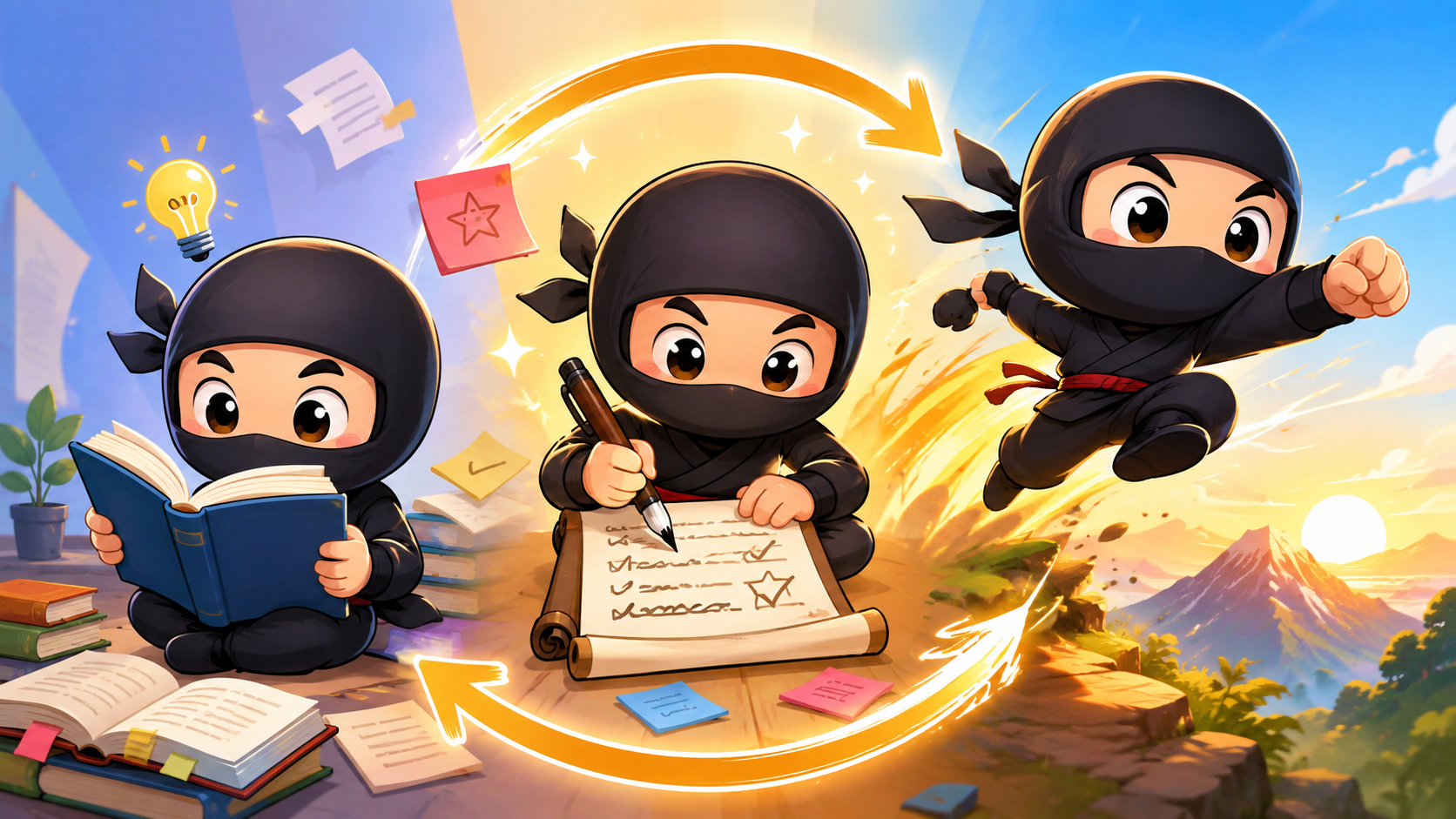
Read → write → get feedback → adjust → learn again.
Then repeat.
That loop is completely different from endless consumption.
When I write an article, I am forced to organize what I actually understand.
Suddenly, vague knowledge becomes embarrassingly visible.
You think you understand something until you try to explain it clearly.
Then your brain says:
“Wait… do we actually know this?”
Writing is brutally useful that way.
And publishing adds another layer.
Someone might read it.
Someone might disagree.
Someone might say:
“That helped me.”
Someone might say:
“Hideic, what on earth are you talking about?”
All of it is information.
Feedback.
Fuel for the next cycle.
That made me realize something.
A blog is not simply a place where I publish what I already know.
It is a training ground where I discover what I still need to learn.
That changes everything.
So if you see more articles from me in the future, blame this book.
Or thank it.
Depending on how annoying I become.
3. The Most Powerful Growth Strategy Is Boring: Keep Going
Another idea that stayed with me was the importance of continuing.
Not doing something perfectly.
Not creating one legendary performance.
Just continuing.
This applies far beyond business.
English.
Exercise.
Reading.
Writing.
Relationships.
Journaling.
Learning.
A single heroic day rarely changes your life.
But ordinary actions repeated for years can take you somewhere your present self cannot even imagine.
I use apps to track things like journaling, English learning, and reading.
And I’ve noticed something.
The easiest way to destroy consistency is to stare too far into the future.
“Can I really do this for five years?”
Terrible question.
My brain hears that and immediately requests a vacation.
A much better question is:
“Can I do it today?”
Today is manageable.
Then tomorrow becomes another today.
Eventually, something that once required effort becomes part of your identity.
And there is another important point Kabasawa emphasizes:
Things are easier to continue when they are enjoyable.
That sounds almost too simple.
But it matters.
If every useful habit feels like punishment, eventually your willpower begins negotiating surrender.
So I try to make growth enjoyable enough that I want to come back.
Read books I’m genuinely curious about.
Write articles that make me laugh while writing them.
Study English in ways that connect with my actual life.
Build routines I can live with instead of routines that look impressive on paper.
I Had Mistaken Consumption for Growth
This may have been the most uncomfortable realization in the whole book.
Self-improvement itself can become entertainment.
You read another book.
Watch another video.
Save another article.
Highlight another quote.
And because all of those things feel productive, you can spend years believing you are moving forward.
But sometimes you are just standing still while consuming information about movement.
That is why output matters so much.
Output creates friction.
It exposes your weaknesses.
It produces results.
It gives you feedback.
And feedback tells you what to learn next.
That is where growth becomes real.
A Japanese Book I Wish More People Could Read
As far as I know, this book has not received a widely available official English edition.
That is unfortunate, because the central idea deserves a much larger audience.
You do not need more information forever.
At some point, you need to:
Speak.
Write.
Try.
Teach.
Build.
Fail.
Adjust.
Repeat.
Knowledge becomes valuable when it escapes your head.
So if you are someone who reads constantly, watches educational content, studies hard, and still secretly wonders:
“Why don’t I feel like I’m changing?”
Maybe you do not need another ten hours of input.
Maybe you need ten minutes of output.
Write one paragraph.
Explain one idea to someone.
Try one thing you learned today.
Create something small.
Ask for feedback.
Do not wait until your understanding feels perfect.
Because output is not the final stage of learning.
Output is part of learning.
And perhaps that is the biggest lesson this book gave me.
Reading can change what you know.
But output changes what you can do.
So now that you have reached the end of this article…
Enough input.
Your turn.
Nin-nin.


コメント