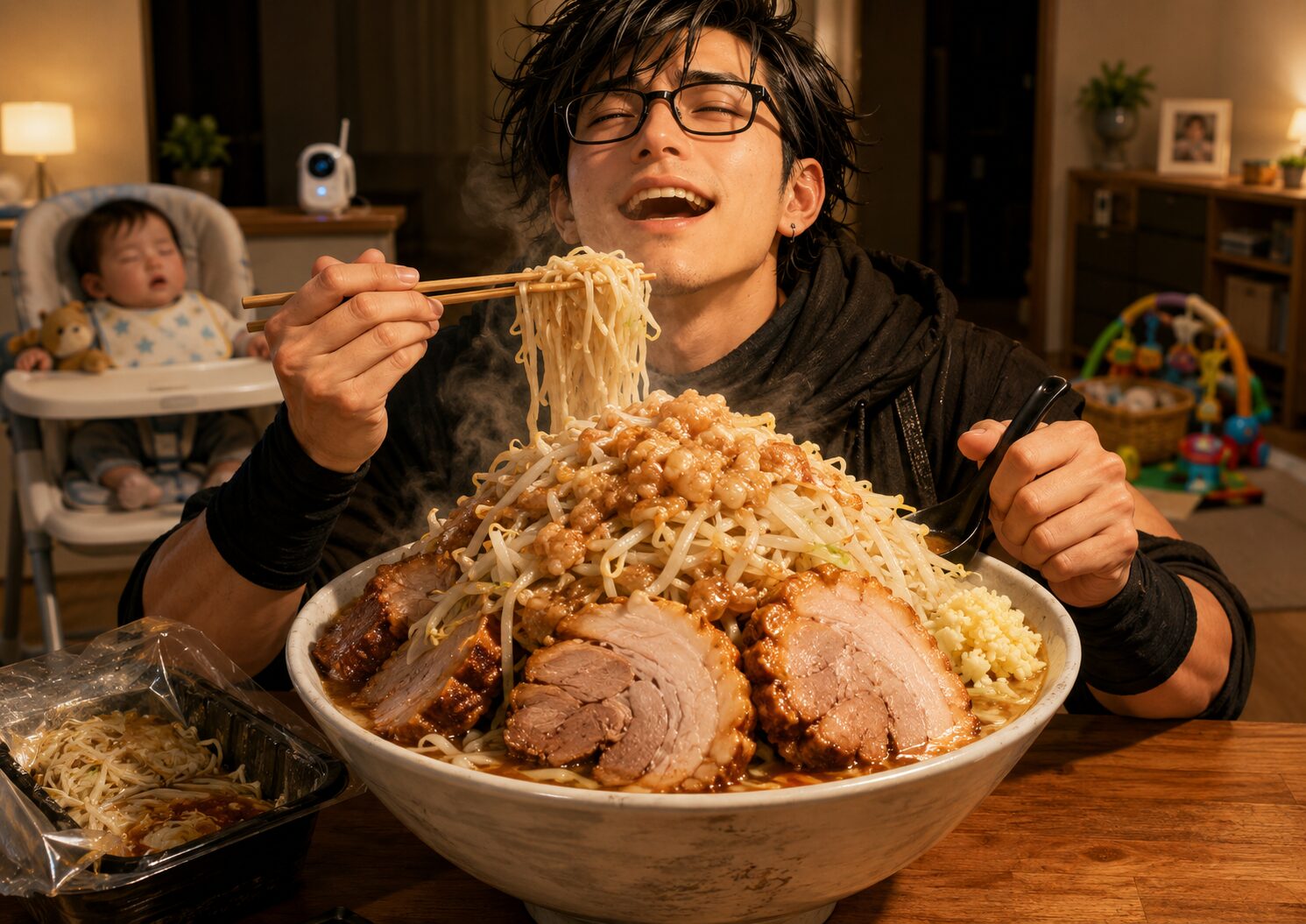
Hi, I’m Hideic.
There are cravings… and then there are cravings.
And lately, the one that’s been haunting me is this:
I want a huge, messy, unapologetically excessive bowl of Japanese ramen.
Not the elegant kind.
Not the delicate kind.
Not the kind you eat quietly while admiring the broth.
I’m talking about the wild kind.
The over-the-top kind.
The kind that looks less like dinner and more like a direct challenge to your future self.
In Japan, there’s a very famous style of ramen often described as “Jiro-style.” It’s known for massive portions, thick chewy noodles, piles of bean sprouts, rich pork fat, strong garlic, and a general attitude of “we are not here to be subtle.” It’s legendary. It’s chaotic. It’s beloved. And it is absolutely not the kind of meal that fits neatly into everyday parenting life.
That, unfortunately, is where I currently live.
Ever since my family enjoyed a ramen event together last autumn, I’ve been quietly carrying around this unresolved desire for a giant bowl of serious ramen. But now that I have a baby, going out to a restaurant for that kind of meal is not exactly simple. Long lines, fast-paced shops, tight seating, strong smells, and the general unpredictability of eating anywhere with a small child all make it… difficult.
Possible? Sometimes.
Easy? Not even a little.
So there I was: a ramen-loving father, trapped between responsibility and noodle longing.
And then, one ordinary day, I walked into a 7-Eleven in Japan and saw something that changed my week.
It was called:
Tomita-supervised Mega Pork Ramen, Extra Fat
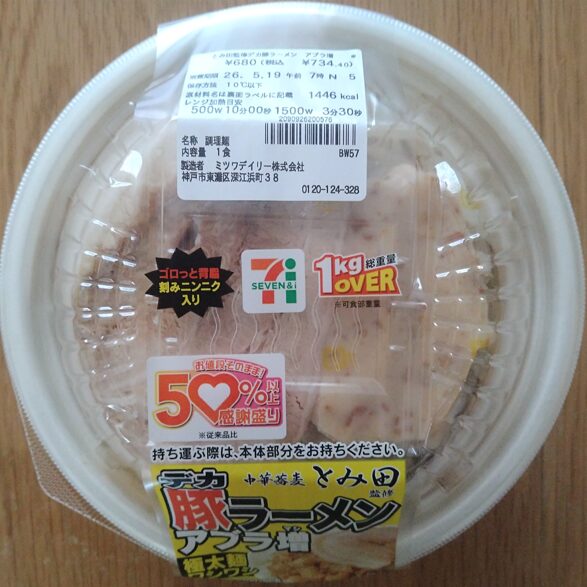
Even the name sounded reckless.
And then I noticed the part that really got me:
Over 1 kilogram in total weight.
I paused.
Tomita, for anyone unfamiliar, is an extremely famous ramen name in Japan. Seeing that name attached to a convenience store ramen already made me curious. But seeing that plus the words “mega pork,” “extra fat,” and “over 1 kilogram” made one thing very clear:
This was not going to be a normal lunch.
At that point, my brain had already made the decision. My body simply followed.
Before I fully realized what was happening, I was standing at the register holding the bowl. The cashier asked if I wanted it heated.
I nearly said yes.
Then, at the last second, I came to my senses.
If I heated it there, then took it home, the noodles might soften too much. And when you’re about to eat a giant, heavy ramen designed to imitate Jiro-style noodles, texture matters.
So I answered, with the sort of suspicious panic that makes innocent employees regret asking simple questions:
“No, no, I’m good. Thank you.”
And then I carried it home like I was transporting sacred cargo.
First: Is It Really Over 1 Kilogram?
Once I got home, I decided I wanted to do more than just eat it. I wanted to inspect it properly. Because I take ramen seriously. Perhaps too seriously.
For context: I’ve eaten many versions of heavy Japanese ramen over the years, including famous spots and various inspired versions. So yes, I admit it — I came into this with opinions.
The package claimed the total weight was over 1 kilogram.
Naturally, I weighed it.
It came out to 1,112.4 grams including the container.
So yes.
This thing was huge.
At that point, I had a brief but honest moment of doubt.
Could I actually finish this?
Then I turned the package over and read the nutrition information.
That was also an experience.
The bowl clocked in at 1,446 calories.
The salt content was 13.3 grams.
For one meal.
I stared at the numbers for a while in respectful fear.
That’s the kind of nutritional label that doesn’t just give information — it gives perspective.
It also reminded me that although I often like to finish ramen broth completely, this was probably not the day to test the limits of my body in the name of noodle devotion.
So before I had even taken a bite, this ramen had already taught me something:
Maybe adulthood means not always drinking all the broth.
A painful lesson.
But perhaps a necessary one.
The Heating Time Alone Told Me This Was Serious
Then I checked the microwave instructions.
10 minutes at 500 watts.
Ten minutes.
That may not sound dramatic, but in convenience-store food terms, that’s long enough to reflect on your choices.
Still, I took it as a good sign.
One of the defining traits of this style of ramen is its thick, dense, chewy noodles. Those noodles take longer to cook. So if this bowl needed that much time, maybe it meant the manufacturers were at least trying to stay true to that style.
Hope rose.
Ten minutes later, I opened the lid.
And honestly?
My first reaction was:
Oh wow. This actually looks like the real thing.
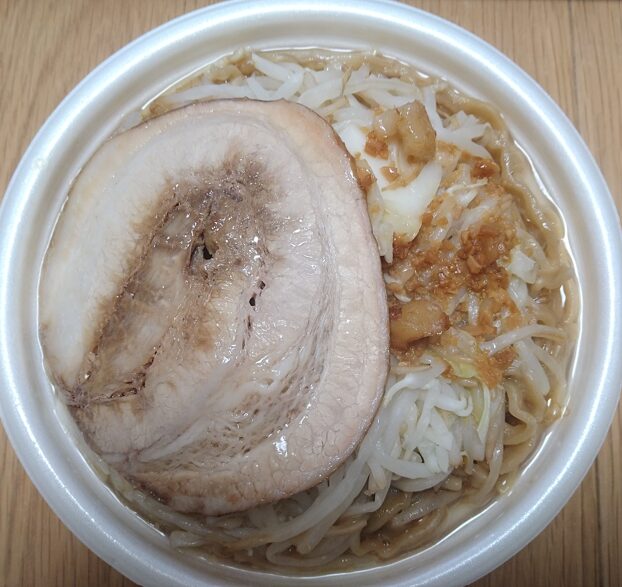
The visual impact was strong. A mountain of bean sprouts. Thick noodles underneath. Chunks of pork. Oil. Rich broth. Garlic-heavy aroma. It had presence.
Now, to be fair, certain things were obviously different from a restaurant version. The bean sprouts weren’t as fresh-crisp as they would be made to order. The pork wasn’t as thick as the massive slabs you sometimes get in shops. But that’s normal. This is convenience-store ramen eaten at home, not a custom bowl served fresh by a team of noodle monks.
And even so, it looked surprisingly convincing.
The pork in particular had enough heft to make me smile.
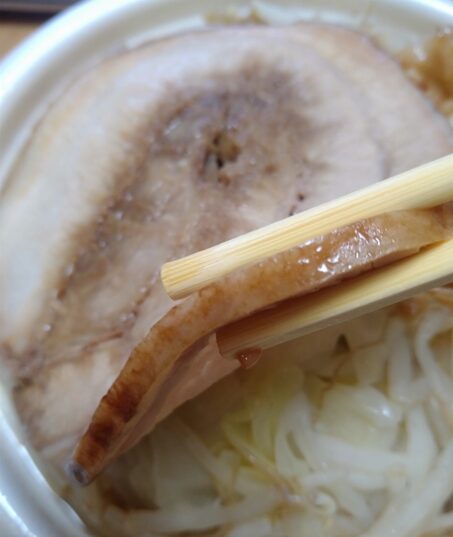
The cabbage mixed in with the bean sprouts was a nice touch too. The whole thing had that same visual message all heavy ramen bowls share:
You are not leaving this table unchanged.
The Technique Begins: Flip the Noodles
Without even thinking, I performed what ramen fans in Japan often do with this kind of bowl:
I flipped it.
In some big ramen styles, the vegetables sit on top while the noodles remain below, soaking in the stronger broth. If you start eating the vegetables first, they can taste a little plain. But if you carefully turn the bowl over — bringing the noodles up and the vegetables down — the vegetables start absorbing the broth more deeply, while the noodles come to the top ready to be eaten at their best.
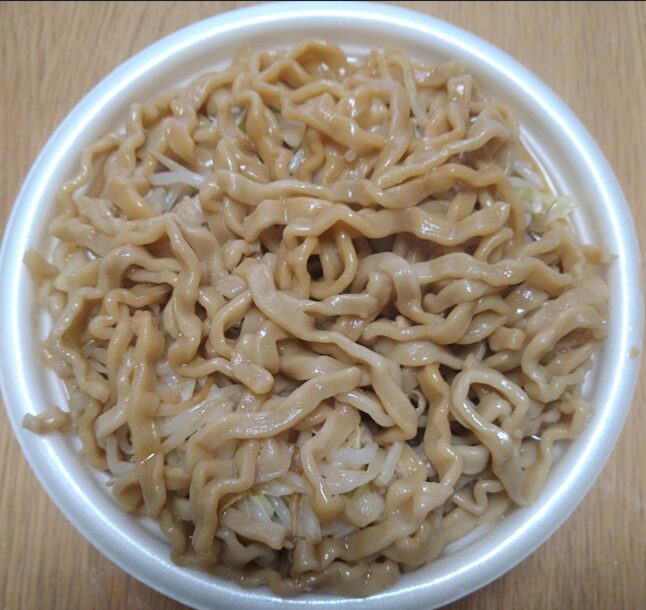
This is not me trying to look cool.
This is survival knowledge.
And yes, I did it automatically. Years of ramen instinct took over before my conscious mind had fully returned.
So… How Did It Taste?
I took the first bite of noodles.
And immediately thought:
Yes. This is what I was hoping for.
The noodles had that rough, heavy, chewy quality that makes this style so satisfying. Maybe they weren’t quite as perfect as a fresh bowl from a specialty restaurant, but they were much closer than I expected.
No joke — if someone had blindfolded me and told me this was some well-made frozen premium ramen product, I would have believed it instantly.
At that moment, I became emotional in a very specific Japanese-food way.
Because what I tasted was not just noodles.
I tasted a relay race of effort — the famous ramen shop name, the convenience store product team, the factory workers, the food developers, the people trying to translate an extreme restaurant experience into something you can microwave in your kitchen while your child naps in the next room.
And somehow, against the odds, it worked.
From there, I stopped being “a father evaluating convenience food” and became “a man fully engaged in combat with a giant bowl of ramen.”
The Egg Upgrade Changed Everything
Halfway through, I decided to do what many ramen lovers do when a bowl becomes especially intense:
I added a raw egg.
This is one of my favorite ways to change the experience. When the noodles and broth get deeper, saltier, heavier, and more repetitive as you eat, dipping the noodles into beaten egg softens everything. Suddenly, the ramen becomes rounder, gentler, almost like a weird and wonderful bridge between giant ramen and sukiyaki-style comfort.
It was excellent.
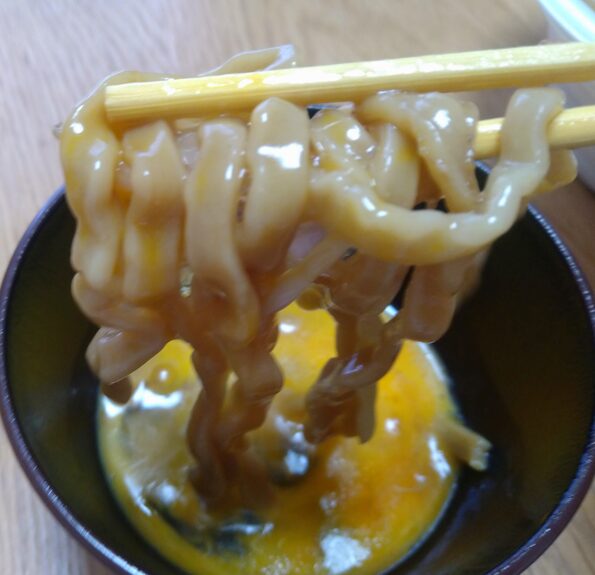
And one of the great joys of eating this kind of ramen at home is that you can do this without paying extra, without asking permission, and without worrying whether the shop offers it.
Home has its own advantages.
By the end, I also remembered that chili pepper would have made a fantastic final flavor change — but unfortunately, I remembered that only after I had already finished.
A tragic tactical error.
I Finished It… But Barely
I managed to stop myself from drinking all the broth. That may not sound heroic, but under the circumstances, it absolutely was.
By the end, I was extremely full. Not “pleasantly satisfied.”
More like:
physically aware of every life decision that led me to this moment.
And yet, I was happy.
Very happy.
Because this bowl had done exactly what I needed it to do.
It gave me the feeling of that huge, excessive, deeply Japanese ramen experience — the kind that is hard to access right now in my season of life — without requiring me to stand in line, rush through a crowded restaurant, or somehow coordinate all of this around parenting logistics.
It didn’t just feed me.
It understood me.
Why This Felt Bigger Than Just Convenience Store Food
One of the things I love about food in Japan is that even convenience stores sometimes take things absurdly seriously.
This is not just a country where you can buy food quickly.
This is a country where someone, somewhere, decided that what exhausted parents and ramen lovers needed was a bowl of microwaveable mega-pork ramen weighing over a kilogram.
And then they actually made it.
That’s funny.
But it’s also kind of beautiful.
Because sometimes culture is not only found in temples, tea ceremonies, or famous historical sites.
Sometimes culture is found in the fact that a convenience store can sell a massive, slightly dangerous, deeply satisfying bowl of ramen that tells you something about modern Japan:
we love precision, excess, comfort, obsession, and taking food far more seriously than anyone probably should.
And honestly?
I respect that.
Final Thoughts
If you’re curious about Japanese food, but you think ramen is just a light noodle soup, let this be your reminder:
Japanese ramen can also be ridiculous.
Heavy.
Messy.
Wildly specific.
And deeply lovable.
And if you’re a parent, or just someone who can’t always chase every great restaurant you want to try, this kind of convenience-store discovery can feel weirdly emotional. It’s not the same as going to the shop itself.
But sometimes it’s enough to carry you through.
Sometimes, in the middle of ordinary family life, a giant bowl of ramen from 7-Eleven can feel like a small act of rescue.
And that, I think, is a story worth sharing.
コメント